5 min read · Pleroma Commerce · 6 sources
In short
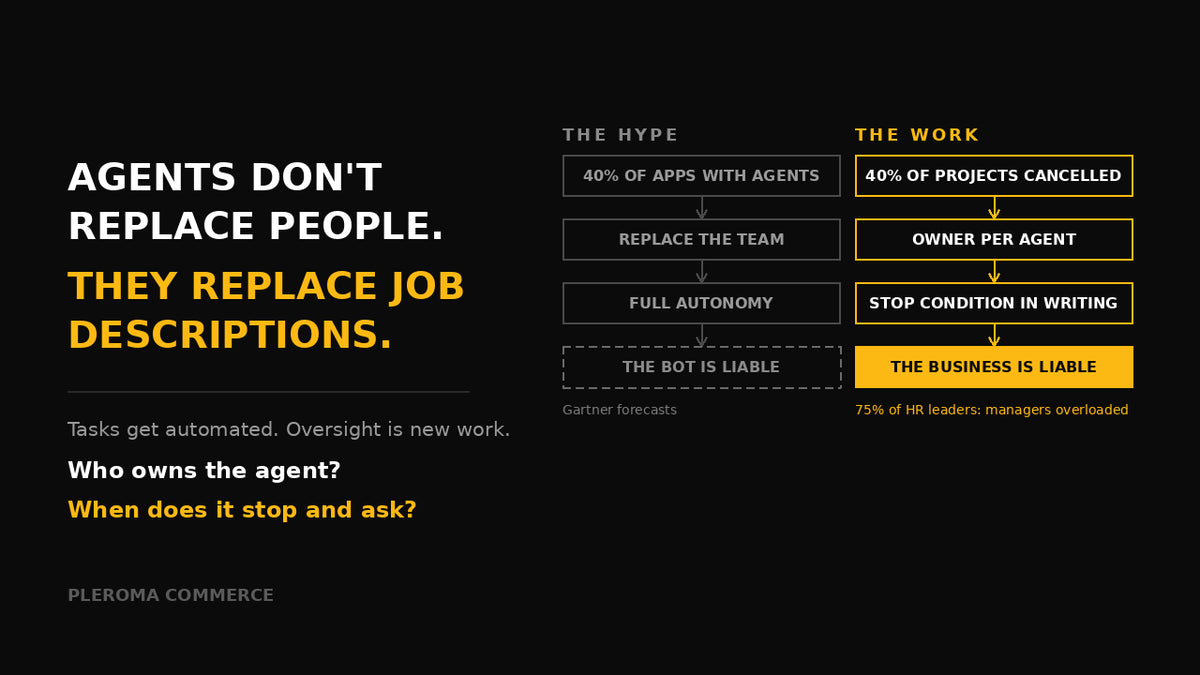
Gartner expects 40% of enterprise apps to include task-specific AI agents by the end of 2026, and over 40% of agentic AI projects to be cancelled by the end of 2027. Agents automate tasks, not whole roles, and the oversight they need is new work: 75% of HR leaders say managers are more overwhelmed than ever. For a store, the practical rules are simple. Sort tasks by risk, give every agent an owner and a written stop condition, and remember that the business, not the agent, is liable for what it says.
In this article
Two Gartner forecasts from the last year sit uncomfortably next to each other. By the end of 2026, 40% of enterprise applications will include task-specific AI agents, up from less than 5% in 2025[1]. And over 40% of agentic AI projects will be cancelled by the end of 2027, because of rising costs, unclear value or weak risk controls. Gartner also estimates that only about 130 of the thousands of vendors selling "agentic AI" are offering the real thing[2].
Both can be true. Agents are arriving in every tool a store already uses, and most companies are not organised to run them. The question an owner should be asking is not whether agents will replace the team. It is who in the team will be responsible for the agents.
Assistant or agent
The difference is not intelligence. It is permission.
An assistant answers when asked. It drafts a product description, summarises reviews, analyses last month's returns. It has no goals and does nothing until a person tells it to.
An agent acts. It watches stock and reorders, changes a price when a competitor moves, replies to a customer, issues a refund, updates a feed. It works towards a goal across several steps, and it can do so while nobody is looking.
Most tools sold as agents today are assistants with a new label. That is not a problem in itself. The problem starts when a business gives an assistant-grade tool agent-grade permissions and nobody decides where it should stop.
The replacement story keeps reversing
In 2024 Klarna said its AI assistant was doing the work of 700 customer service staff. In 2025 its chief executive said the company would start hiring people again, because customers needed to be able to reach a human and quality had suffered[3]. The technology did not fail. The assumption that a whole role could be removed did.
Gartner's May 2026 research on manager oversight explains why. Agentic AI does not reduce management effort; it often increases it, because someone now has to check the agent's inputs and verify its outputs. 75% of HR leaders report that managers are more overwhelmed than ever, and one in four managers say they would give up the role if they could[4]. Its advice to companies planning to cut management layers on the strength of AI is to do the opposite first: before changing manager headcount or scope, measure how many agents each team runs and how autonomous they are.
What gets automated is tasks and pieces of processes. What appears in their place is oversight, and oversight is work.
Autonomy is a design decision
How much an agent does on its own is not set by the vendor. It is set by the business: what data the agent can see, what it is allowed to change, and what makes it stop. Gartner recommends measuring a team not by headcount but by span of complexity: how many agents are running, how autonomous they are, and how directly their output is tied to business risk[4].
In a store, that sorts tasks into three levels. Low risk: drafting descriptions, tagging products, summarising reviews. The agent acts and a person checks a sample. Medium risk: replies to customers, changes to marketplace feeds. The agent drafts, a person approves anything above a set threshold. High risk: prices, refunds above a limit, anything that touches compliance fields. A person decides and the agent prepares.
Every agent needs one sentence written down before it goes live: when does it stop and ask a human?
The liability stays with you
In 2024 Air Canada argued before a Canadian tribunal that its website chatbot was responsible for its own statements after it gave a customer wrong information about a refund. The tribunal rejected the argument and the airline paid[5]. An agent does not carry liability. The company that deployed it does.
The regulation points the same way, with a nuance worth getting right. The AI Act's human oversight requirements in Article 14 apply to high-risk systems, such as those used in hiring or credit scoring, and the Digital Omnibus agreed in 2026 moved those obligations to 2 December 2027[6]. A listing generator or a support bot in a Shopify store is not high-risk. It is still covered by the Act's transparency rules on telling customers they are talking to a machine, by GDPR for every piece of customer data it touches, and by consumer law for every promise it makes. The law does not require a human in the loop for most store agents. A court will still hold the store responsible for what the agent said.
Five questions before the first agent
Does the team know which of its tools are assistants and which are agents? Does every agent have a named owner who answers for its results? Is there a written point where each agent stops and asks? Is there a list of what each agent can read and change? Can someone see, tomorrow morning, what every agent did yesterday?
If any answer is no, the business is not ready for agents. It is ready for assistants, which is a perfectly good place to start.
At Pleroma we write down the owner, the permissions and the stop condition before an agent touches a client's store.
Agents do not replace people. They replace the job description. The companies that write the new one first will not have to rehire for the old one.
Pleroma Commerce
Agents need an owner before they need a budget
A five-day audit of the store and every channel, including which tasks are ready for automation and which are not.
See the store and channel audit →Sources
- Gartner, "Gartner Predicts 40% of Enterprise Apps Will Feature Task-Specific AI Agents by 2026, Up from Less Than 5% in 2025", press release, 26 August 2025. gartner.com
- Gartner, "Gartner Predicts Over 40% of Agentic AI Projects Will Be Canceled by End of 2027", press release, 25 June 2025. gartner.com
- Bloomberg, interview with Klarna CEO Sebastian Siemiatkowski, May 2025.
- Gartner, "Agentic AI: How CHROs Can Redefine Manager Oversight", May 2026. gartner.com
- Moffatt v. Air Canada, 2024 BCCRT 149, Civil Resolution Tribunal of British Columbia, February 2024.
- Sidley Austin, "EU Lawmakers Reach Provisional Agreement to Delay Key EU AI Act Obligations", Data Matters, June 2026. datamatters.sidley.com