4 min read · Pleroma Commerce · 3 sources
In short
Most agencies split e-commerce across six specialists, each optimising their own number. The number that pays the bills lives between their reports, and nobody is hired to read it. Pleroma is built on operators who have each run at least three of the disciplines in production, works with a maximum of five brands at a time and starts every engagement with an audit. As AI takes over the trainable halves of the work, the judgment across them is what is left to pay for.
In this article
Why we don't hire specialists
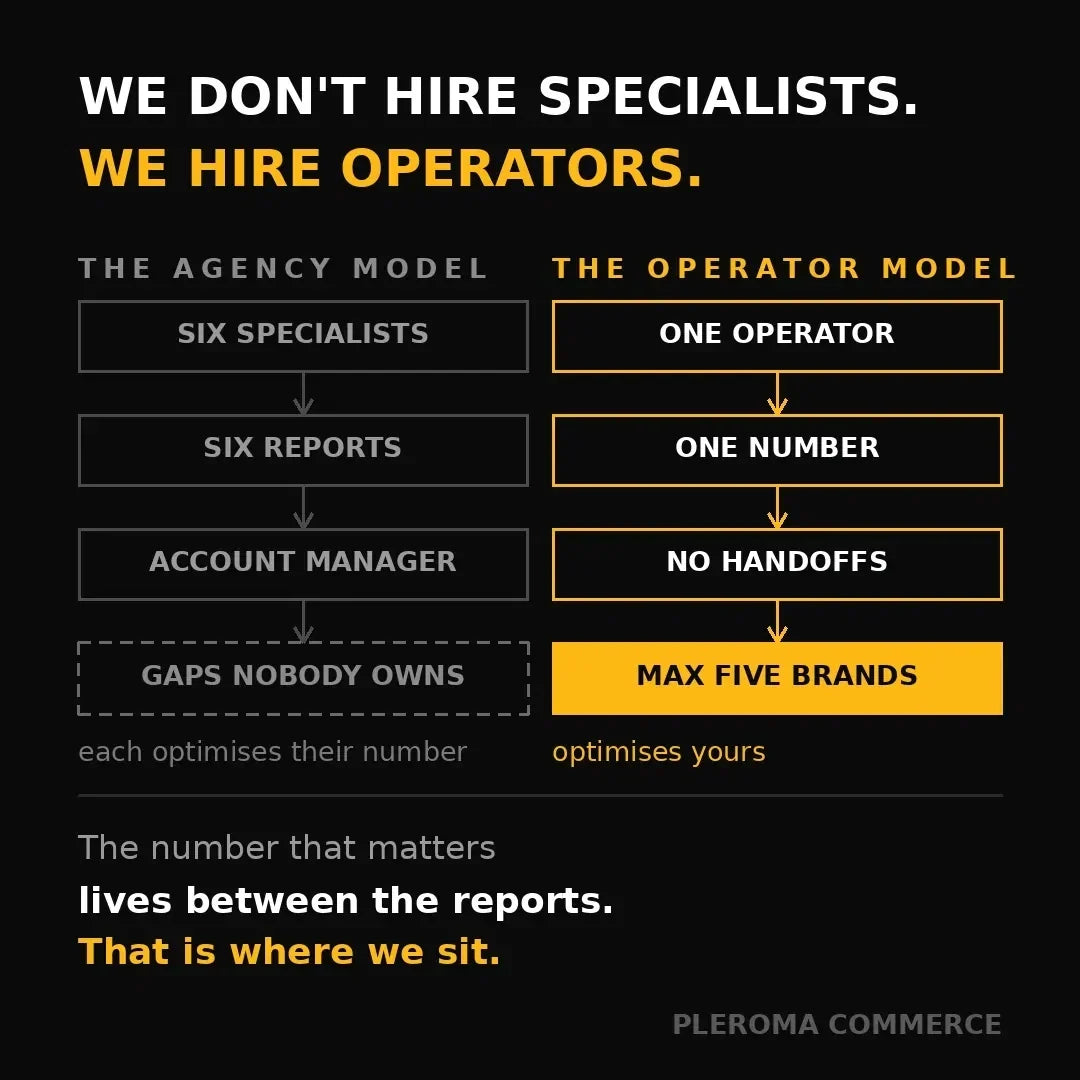
Every agency pitch you've read this year lists the same team: a media buyer, a copywriter, a Shopify developer, a marketplace specialist, an analyst, an account manager to hold them together. Six people, six job titles, six reports. It looks thorough. It is also the reason most e-commerce accounts underperform, and it is the one thing we set out not to build.
The problem is in the gaps
Naval Ravikant separates specialized knowledge, which a course can teach, from specific knowledge, which it cannot. His test is simple: if society can train you to do something, it can train someone else and replace you[1][2]. Scott Adams made the practical version of the same point years earlier. Don't try to be the best in the world at one thing. Be top 25% at two or three things that rarely sit in the same person. He called it a talent stack[3].
E-commerce is where these two ideas stop being philosophy and start being a P&L. An online channel needs someone who reads margin and knows what a ROAS figure is hiding. Someone who writes product copy and understands how the tracking behind the page is wired. Someone who configures a store and knows why the warehouse cut-off matters more than the theme.
Each half is a specialization with a certificate attached. The market is full of them. What the market does not have is people who hold two or three halves at once, because nobody trains for the intersection. There is no course called "ads plus margin". You get there by having done both, usually badly at first.
When a brand splits this work across six specialists, each one optimises their own number. Ads optimises ROAS. Content optimises rankings. Development optimises the theme. Nobody optimises the thing that pays the bills, because that number lives between the reports, in the place the org chart never budgets for. The account manager is supposed to read across the gaps. The account manager has never run a store.
How we built around this
We are a small team of multi-channel commerce operators, and small is a design choice, not a stage. Every person here has run at least three of the following in production: Shopify storefronts and migrations, marketplace launches across Amazon, Allegro, eBay, Kaufland, Erli, bol and ManoMano, catalogue and listing production with per-channel keyword research, PIM and ERP integration, EU compliance from VAT OSS through WEEE and GPSR, Klaviyo retention, and performance tracking. Not "has been briefed on". Has run.
That changes what the work looks like from your side. There is no handoff between the person who wrote the listing and the person who checked the compliance fields, because it is the same person. There is no meeting to reconcile the ads report with the margin report. The person who set the campaign live already knew the margin before choosing which products to promote.
It also puts a hard ceiling on how many brands we can work with. Operators do not scale the way specialists do. You cannot add a junior and a checklist and get the same result. So we work with a maximum of five brands at a time, and we start every engagement with an audit, because the audit is where we find out whether your problem is in a channel or in the gaps between channels. It is almost always the gaps.
The 2026 version of this argument
There is one more reason this matters now. Every trainable half of e-commerce work is the half that AI now does adequately. Product descriptions, feed optimisation, basic reporting, first-draft ad copy. That is not a threat to the model above. It is the reason for it. What automation cannot do is decide which lever to pull when the ads number and the margin number disagree, or notice that a marketplace listing is technically compliant and commercially dead. That judgment was always the valuable part of the job. It is now the only part worth paying a human for.
Specialized is a credential. Specific is what you are actually hiring.
Pleroma Commerce
Find the gaps first
Every engagement starts with a five-day audit that shows whether the problem sits in a channel or between channels.
See the store and channel audit →Sources
- Naval Ravikant, "How to Get Rich (without getting lucky)", Twitter thread, May 2018.
- Eric Jorgenson, The Almanack of Naval Ravikant, Magrathea Publishing, 2020.
- Scott Adams, How to Fail at Almost Everything and Still Win Big, Portfolio, 2013.