5 min read · Pleroma Commerce · 5 sources
In short
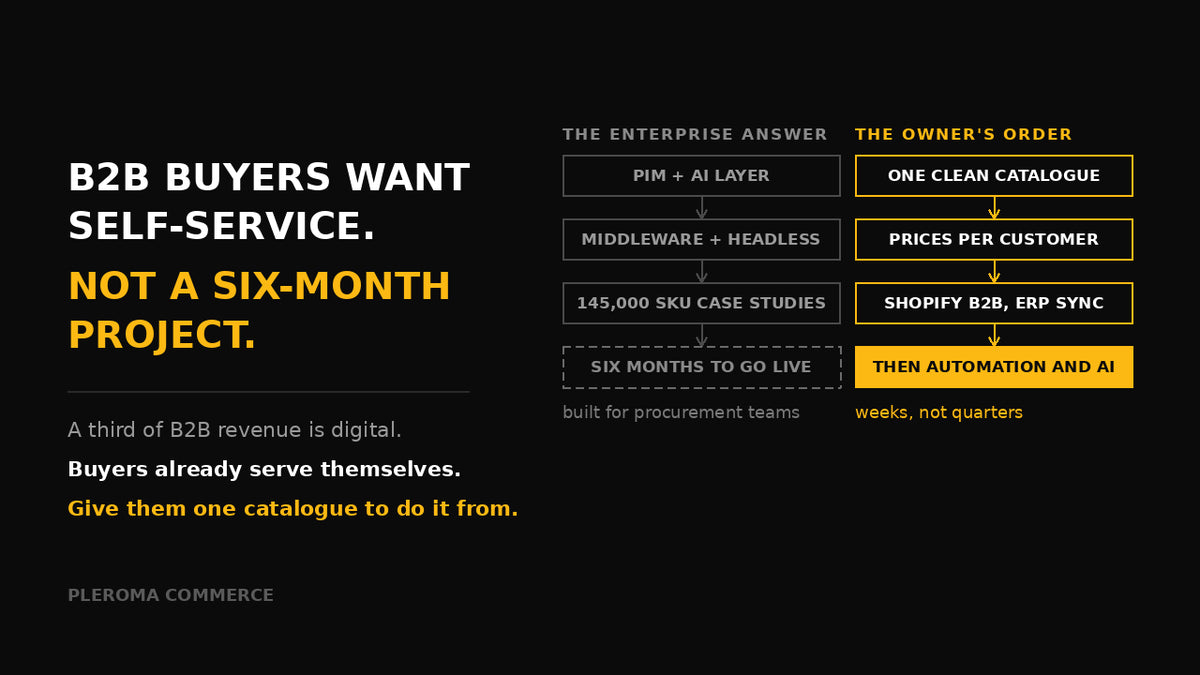
B2B buyers now expect what they get as consumers: live prices and stock, order history, their own terms, no phone call. Enterprise vendors answer with PIM, middleware and headless architecture built for six-figure catalogues. An owner-run distributor gets most of the result from four steps in order: one clean catalogue, prices and terms per customer inside the system, one self-service channel on Shopify B2B, and stock and orders synced with the ERP. Automation and AI come after, when there is data for them to run on.
In this article
The B2B buyer changed before most suppliers noticed. McKinsey's 2026 B2B Pulse survey of 3,664 decision makers found that 71% of suppliers now offer e-commerce, and among those that do, roughly a third of revenue flows through digital channels, making it the top revenue-generating channel[1]. In the 2024 edition, 20% of buyers said they were comfortable spending a million dollars or more through self-service or remote channels, up from 15% two years earlier[2]. Wind turbine parts, MRI scanners and crawler cranes are being bought without a handshake.
Meanwhile, at a typical owner-run manufacturer or distributor, an order still arrives as an email with a PDF attached. A sales rep retypes it into the ERP. The customer calls to ask whether the item is in stock, because the price list they have is from February and says nothing about availability. Nobody in this chain is doing anything wrong. The process is simply twenty years older than the buyer.
The enterprise answer and the SME problem
The vendors who write about this gap tend to answer it with architecture. A PIM with an AI layer, an integration middleware, a headless CMS, a pricing engine, a cloud migration, and case studies that start at 145,000 SKUs. None of that is wrong. It is designed for a company with a procurement department, an IT team and a two-year horizon.
An owner-run business with 3,000 products, an ERP such as Comarch or Subiekt, a catalogue in Excel and four sales reps does not have that horizon, and does not have the problem that architecture solves. It has four smaller problems that compound.
What actually blocks B2B self-service
Product data lives in three places. The ERP holds the SKU and the cost. Excel holds the description and the technical fields. The rep's head holds which product replaces which. No system can show a customer a complete product because no system has one.
Individual pricing lives outside any system. Customer A gets 12% off list, customer B gets 15% on category X and 8% on category Y, customer C has a fixed price agreed in 2023. These terms exist in email threads and in the reps' memory. A self-service portal that shows list prices to everyone is worse than no portal, because it tells the best customers they are being overcharged.
Stock is not connected to the store. Availability is checked by phone because the website either does not show it or shows yesterday's number.
Orders are retyped. Every order that arrives by email is entered twice: once by the customer, once by the rep. Every retype is a chance to ship the wrong quantity to the wrong address on the wrong terms.
Solve those four and most of what buyers are asking for is done. The architecture can wait.
The order that works
Catalogue first. One record per product with every field a channel needs: technical attributes, packaging units, minimum order quantities, images, compliance data. This is the least glamorous step and the one that decides everything after it. A business that has run 15,000 spare-parts SKUs across eight channels did it from one catalogue in BaseLinker, with virtual stock levels synced to Comarch ERP XL, not from eight separate product databases.
Prices and terms per customer, in the system. Since April 2026, Shopify's B2B features are included on every paid plan: company profiles with multiple buyers, up to three price catalogues, volume tiers, net payment terms and PO numbers at checkout[3]. Unlimited catalogues and a dedicated B2B storefront still need Shopify Plus, but a distributor with a handful of customer tiers does not need unlimited. It needs the terms it already grants, written down somewhere a customer can log in and see.
One self-service channel. A store where a business customer logs in, sees their prices, sees live stock, reorders from history and pays on their agreed terms. Not a portal, not a marketplace, not an app. One channel, done completely, before a second one is opened.
Stock and orders synced with the ERP. Stock flows out of the ERP into the store; orders flow back in. The rep stops retyping and starts selling. This is an integration project measured in weeks, not a middleware project measured in quarters.
Then automation and AI. Once the catalogue is complete and the orders flow without retyping, AI listing generation, automated reorder prompts and agent-based support have something to run on. Before that, they have nothing to run on, and they will run anyway.
The second channel and the paperwork
The same catalogue that feeds the store feeds Amazon Business in Germany and Allegro Biznes in Poland, both of which offer VAT invoicing, net terms and quantity pricing to business buyers[4]. Allegro reported in 2022 that one in three Polish companies buys there every month. A distributor that has done step one can be listed on both in weeks. A distributor that has not will list the same broken data in two more places.
Digital invoicing closes the loop. Poland's KSeF e-invoicing mandate has applied to all VAT-registered businesses since April 2026, with penalties from January 2027[5], and the EU's ViDA package extends structured e-invoicing across member states over the coming years. An order that enters the ERP through an integration produces a compliant invoice automatically. An order retyped from an email produces one more place for the numbers not to match.
At Pleroma, every B2B engagement starts with the catalogue, because it is the one step that cannot be skipped and the one most projects try to.
The buyer already wants to serve themselves. The question is whether the supplier gives them one clean catalogue to do it from, or a six-month roadmap to wait for.
Pleroma Commerce
Start with the catalogue
A five-day audit of the store, the catalogue and every channel, with a 90-day plan in the order the data supports.
See the store and channel audit →Sources
- McKinsey & Company, "The surprising economics of B2B growth", May 2026. Global B2B Pulse Survey, December 2025, n=3,664. mckinsey.com
- McKinsey & Company, "Five fundamental truths: How B2B winners keep growing", September 2024. Global B2B Pulse Survey, April 2024, n=3,942. mckinsey.com
- Shopify Help Center, "Overview of B2B features on Shopify", 2026. help.shopify.com
- Allegro, "Allegro Biznes" press information via ISBnews, April 2022. comparic.pl
- Ministry of Finance (Poland), "KSeF 2.0 w pytaniach i odpowiedziach", via podatki.biz. podatki.biz