4 min read · Pleroma Commerce · 4 sources
In short
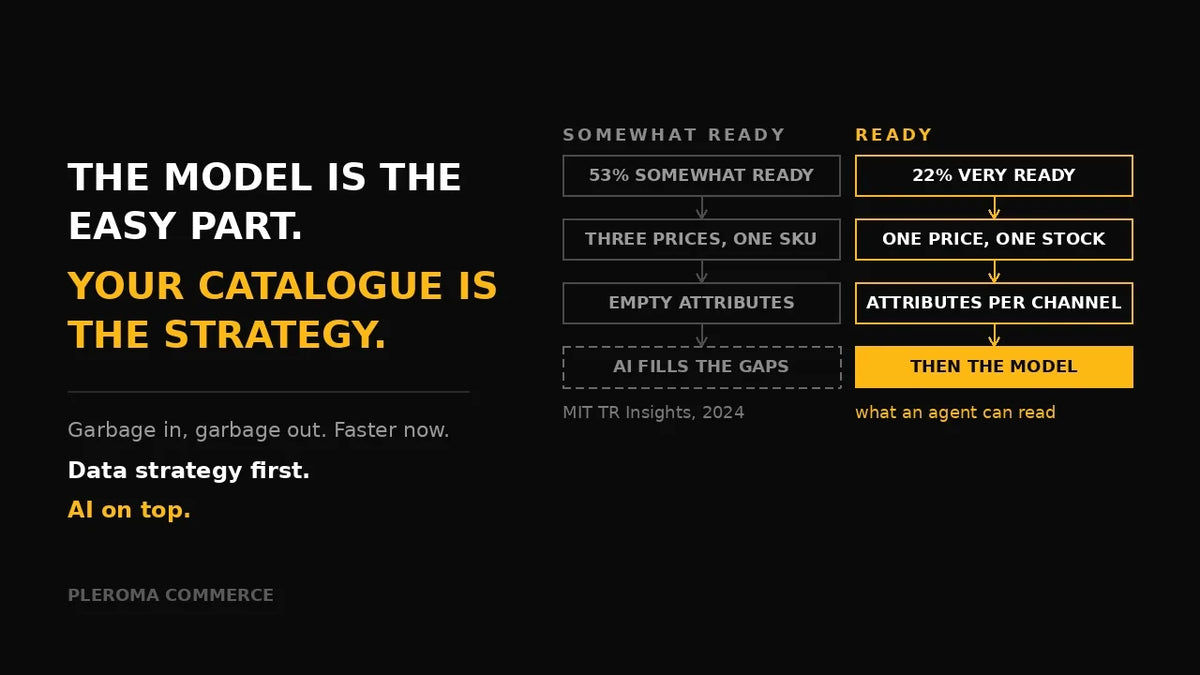
In 2024, only 22% of executives called their data foundations very ready for AI, and 53% said somewhat ready. For an e-commerce brand the data foundation is the catalogue: attributes, prices, stock, compliance fields, the customer file. AI listing tools and shopping agents read from it and nothing else, so every gap becomes a confident error. Fix the catalogue first, then buy the model.
In this article
In May 2024, MIT Technology Review Insights polled 275 executives on their generative AI plans. 72% wanted efficiency. 55% wanted a competitive edge. Then came the question that mattered: how ready are your data foundations? 22% said very ready. 53% said somewhat ready. A quarter admitted they were not[1].
The report is two years old, sponsored by a data platform vendor and focused on large enterprises. It has aged unusually well, because the problem it describes is older than the technology. The models have improved every quarter since. The data has not.
What "somewhat ready" means in a store
Accenture's Arnab Chakraborty put it plainly in that report: on data quality, "50% ready is not good enough"[1]. For an e-commerce brand, the data foundation is not a warehouse of documents. It is the catalogue. Attributes, images, prices, stock levels, variant logic, compliance fields, reviews, the customer file. Every AI use case a Shopify brand is being sold this year, from generated listings to agent-driven shopping, reads from that catalogue and nothing else.
Somewhat ready, in practice, looks like this. Forty percent of products have empty attribute fields. Three SKUs describe the same item under different titles. The price in the ERP differs from the price in Shopify, which differs from the price on the marketplace. Stock syncs hourly on one channel and by hand on two others. None of this stopped a human from selling. All of it stops a machine.
Three old problems, one new consequence
The report names the barriers: data governance at 59%, data quality at 53%, data integration at 48%[1]. Chakraborty notes these are issues the industry has "heard about for 10 years". Neil Ward-Dutton of IDC adds the sharper version: plenty of companies are "still using, basically, Excel for everything".
In e-commerce these three have exact equivalents.
Governance is the question of which system holds the truth. If nobody can say whether the ERP, the store or the marketplace owns the price, an AI pricing tool has three answers and picks one.
Quality is attribute completeness and consistency. An AI listing generator does not know a field is empty. It fills it, confidently. The hallucination the report warns about, a chatbot promising a return policy that does not exist, is in e-commerce a listing that promises a certification the product does not have. Under GPSR and marketplace policy, that is not a content error. It is liability.
Integration is the plumbing between PIM, ERP, store and channels. The average Shopify store runs 6.2 third-party apps[2]. Each is a place where the data can be slightly different.
Why it matters more in 2026 than in 2024
Two things changed. First, AI stopped being a drafting tool and started being an actor. Shopping agents compare structured product data across stores. Adobe measured AI-referred traffic to US retail sites up 393% year on year in Q1 2026, converting 42% better than traditional traffic by March[3]. The same report found roughly a third of category pages still unreadable to AI agents. A beautiful product page with three empty attributes loses to a plain one with twelve.
Second, most teams are not using AI to find the data problems. AppsFlyer's analysis of more than 8,000 AI analytics queries from e-commerce brands found only 4% were diagnostic[4]. The rest were lookups. The tools that could surface a broken catalogue are being asked what yesterday's ROAS was.
The report's line on hallucination is the useful frame here. Snowflake's head of AI describes investing in systems that know when not to answer[1]. In a store, that is a listing pipeline that refuses to publish when a compliance field is empty, not one that writes something plausible into it.
What a ready catalogue looks like
One source of truth for price and stock, with every channel reading from it. Attribute standards per channel, because Amazon, Allegro and a Shopify storefront index different fields. PIM and ERP connected, not exported. Compliance data, the GPSR responsible person, WEEE registration, packaging, stored as product data rather than as a PDF in a shared drive. A customer file that is one list, not four.
Then, and only then, the model.
The word "strategy" in the report's title is doing the work. Companies do not need an AI strategy. They need a data strategy that AI can run on. The order is not optional. Every brand that buys AI tooling before fixing the catalogue pays twice: once for the tool, once for the cleanup it made unavoidable.
At Pleroma, catalogue readiness is the first thing the audit checks, before any tool is recommended.
The model is the easy part. Your catalogue is the strategy.
Pleroma Commerce
Catalogue readiness is the first audit check
Every engagement starts with a five-day audit of the store and every channel it sells through. Data comes before tooling.
See the store and channel audit →Sources
- MIT Technology Review Insights, "Data strategies for AI leaders", produced in partnership with Snowflake, 2024. Poll of 275+ executives, May 2024.
- StoreCensus, "Shopify App Statistics & Market Data", September 2026. storecensus.com
- Adobe Analytics via TechCrunch, "AI traffic to US retailers rose 393% in Q1", 16 April 2026. techcrunch.com
- AppsFlyer, "The State of eCommerce for Marketers, 2026 Edition", May 2026. appsflyer.com