
4 min read · Pleroma Commerce · 3 sources
In short
Klaviyo announced on 16 October 2026 that Composer can build, test and operate Customer Agent within its marketing workspace. Shopify merchants serving several countries should test answers against local policies before relying on an AI assistant.
What changed
Klaviyo’s October update brings Customer Agent setup, testing and analysis into Composer. The company describes a shared workspace for marketing activity and customer conversations, rather than a separate agent-building screen. This is an interface change, not evidence that every customer query will be answered correctly.[1]
According to Klaviyo’s help centre, Composer replaces the former Build tab for Customer Agent. An authorised user can ask it to edit instructions, improve knowledge, test scenarios, inspect conversations and review hand-offs. Importantly, approved changes to guidance and knowledge can take effect immediately. Review proposals before confirming them.[2]
Why it matters for European stores
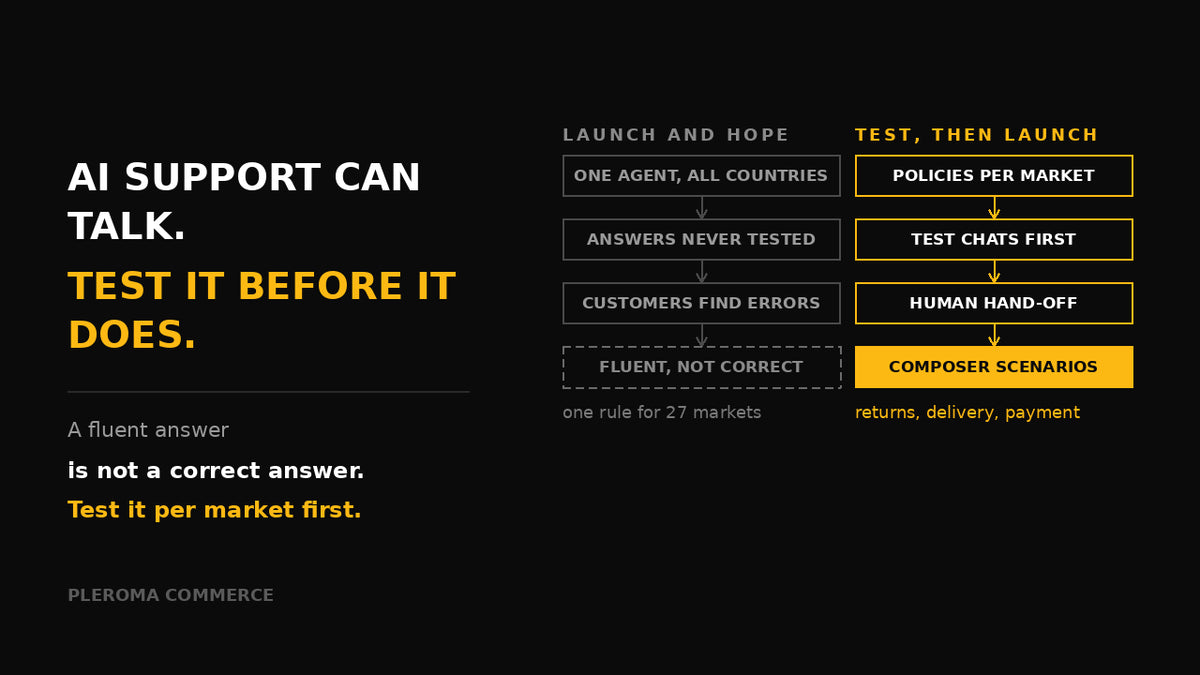
Imagine a shopper in Poland asking about a return while another shopper asks the same question from France. Shipping options, return procedures, product availability and displayed currency may differ. A fluent answer is not necessarily the right answer for that market.
Klaviyo says Customer Agent can assign knowledge and skills to regions, countries or synced Shopify Markets. Unassigned resources apply to all regions by default. Shopify Markets is optional for regional content rules, but its integration can provide market-specific product recommendations, prices and currencies. These features still require deliberate configuration and testing.[3]
The practical benefit is a clearer review process. Instead of guessing whether the assistant understands a policy, store teams can create a scenario, inspect the response and correct the source. Do not treat automated replies or vendor claims as proof of reduced support costs.
How to apply
- Check access first. Open Klaviyo Customer Agent and confirm your account has access and your role can edit it. Open Composer from a Customer Agent page. Avoid changing a live rule just to experiment.[2]
- Map your source material. Separate universal answers, such as contact details, from country-specific delivery, returns and payment policies. Assign local sources to the correct regions. Check that no local rule accidentally remains available to all shoppers.[3]
- Test representative conversations. Use Composer or the Playground to ask about a delayed parcel, a return and a product recommendation for different countries. Compare each answer with the approved policy, store data and applicable market configuration.
- Review and monitor. Confirm any proposed edits only after checking their wording and scope. Re-run the failing scenarios, establish a human hand-off for uncertain cases and examine real conversations after activation. Record what was changed and why.
Start with the questions your team already receives, not a broad claim that AI can replace support. An audit of your store and sales channels can help identify which product and policy data need attention first.
Review the store and channel auditSources
- Klaviyo, What’s New, “Build Customer Agent with Composer”, published 16 October 2026. https://www.klaviyo.com/whats-new
- Klaviyo Help Center, “How to build, test, and analyze Customer Agent with Composer”, updated 9 October 2026, accessed 23 October 2026. https://help.klaviyo.com/hc/en-us/articles/56974158507803
- Klaviyo Help Center, “How to set up Customer Agent for multiple countries and regions”, updated 14 October 2026, accessed 23 October 2026. https://help.klaviyo.com/hc/en-us/articles/57202526968731